Imagine having the power to relieve your own jaw pain in just a few minutes, using nothing but your hands.
No appointments. No equipment. No medications.
Just you, your fingertips, and the knowledge of exactly where to press.
As a TMJ specialist, I’ve treated thousands of patients over the years, and one of the most empowering things I can teach someone is self-massage. Because while professional manual therapy is incredibly effective, you can’t see me every time your jaw flares up. You need tools you can use at home, at work, or anywhere tension strikes.
The truth is: Three specific spots on your head and neck hold the vast majority of your jaw tension. Master these three areas, and you’ll have the ability to manage your TMJ symptoms independently, reduce your reliance on pain medication, and prevent minor tension from escalating into full-blown pain episodes.
In this comprehensive guide, I’ll teach you:
- The exact 3 spots to massage for maximum TMJ relief
- Step-by-step instructions for each technique
- How long and how often to massage
- What you should (and shouldn’t) feel
- How to combine these techniques for a complete self-care routine
- When self-massage isn’t enough and you need professional help
Let’s start with understanding why these three specific spots matter so much.
Why These 3 Spots? Understanding TMJ Muscle Dysfunction
Before we dive into the techniques, let’s understand the anatomy and why these particular muscles are the key players in TMJ pain.
The TMJ Muscle Network
Your jaw doesn’t work in isolation. It’s part of a complex network of muscles throughout your face, head, and neck. When we talk about “TMJ pain,” we’re usually talking about dysfunction in one or more of these muscles:
Primary Jaw Muscles:
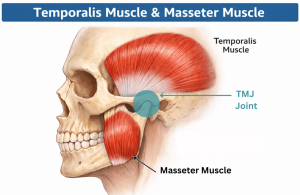
- Masseter (closes jaw, main chewing muscle)
- Temporalis (closes jaw, helps with chewing)
- Medial pterygoid (closes jaw, side-to-side movement)
- Lateral pterygoid (opens jaw, forward movement)
Supporting Neck Muscles:
- Sternocleidomastoid/SCM (head rotation and flexion)
- Upper trapezius (shoulder and neck stabilization)
- Suboccipitals (head position and stability)
- Scalenes (neck stabilization, breathing assistance)
All of these muscles can contribute to TMJ dysfunction, but three of them are:
- Most commonly tight in TMJ patients
- Accessible for self-massage (you can reach them effectively)
- Highly responsive to self-treatment when done correctly
Those three muscles are:
- Masseter (jaw muscle)
- Temporalis (temple muscle)
- SCM (neck muscle)
Let me introduce you to each one.
Spot #1: The Masseter (Your Jaw Muscle)
What It Is
The masseter is your primary chewing muscle—thick, powerful, and rectangular. It runs from your cheekbone down to the angle of your lower jaw.
Location: Place your fingers on your jaw, about halfway between your ear and chin. Clench your teeth briefly and you’ll feel it bulge. That’s your masseter.
Size: About the size of your thumb, but it can hypertrophy (grow larger) with chronic clenching, making some people’s jaw appear more square or muscular.
What It Does
The masseter is one of the strongest muscles in your body relative to its size. It:
- Elevates your jaw (closes your mouth)
- Generates tremendous bite force (up to 200+ pounds per square inch)
- Works constantly during chewing, talking, and swallowing
- Stabilizes your jaw during movement
Why It Gets Tight and Painful
Your masseter becomes chronically tight and develops trigger points from:
Overuse:
- Chronic clenching (conscious or unconscious)
- Nighttime grinding (bruxism)
- Chewing tough foods excessively
- Chewing gum habitually
- One-sided chewing (favoring one side)
Stress:
- Jaw clenching is a common stress response
- Many people unconsciously clench during:
- Work stress
- Driving in traffic
- Intense exercise
- Anxiety or emotional distress
Poor Jaw Mechanics:
- Clicking or deviation when opening
- Compensating for disc displacement
- Muscle imbalance between left and right sides
Postural Issues:
- Forward head posture changes masseter activation patterns
- Creates chronic low-level tension throughout the day
Masseter Pain Patterns
When your masseter is tight or has trigger points, it creates:
Local Pain:
- Jaw pain along the muscle itself
- Soreness when chewing
- Feeling of “fullness” or tightness in your jaw
Referred Pain:
- Above and behind the eye (feels like sinus pressure)
- Eyebrow area
- Upper and lower teeth (can mimic toothache)
- Ear pain or fullness
- Temple area
Functional Problems:
- Difficulty opening mouth fully
- Pain when chewing (especially tough foods)
- Jaw fatigue after eating
- Limited jaw mobility
The Masseter Self-Massage Technique
Now let’s get to the technique.
Step 1: Locate the Masseter
- Place your fingertips (index, middle, and ring fingers) on your jaw
- Position them about halfway between your ear and the corner of your mouth
- Clench your teeth gently to feel the muscle bulge
- Relax your jaw—keep your fingers on that spot
Pro tip: The muscle has different sections:
- Superficial (outer) layer: The part you can easily feel
- Deep layer: Underneath, harder to access
- Upper attachment: Near your cheekbone
- Lower attachment: Angle of your jaw
You’ll work the entire muscle, but start with the most accessible middle section.
Step 2: Apply Circular Pressure
The Technique:
- Press firmly into the muscle with your fingertips
- Make small, slow circular motions
- Work in one spot for 10-15 seconds, then move to the next
- Cover the entire muscle:
- Start at the top (near cheekbone)
- Work down to the middle
- Finish at the bottom (angle of jaw)
- Repeat on the other side
Pressure Guidelines:
- Firm enough to feel it working (5-7 on pain scale)
- Not so hard you tense up or can’t breathe
- “Hurts so good” sensation
- Should feel like you’re working INTO the muscle, not just rubbing the surface
Duration: 30-60 seconds per side
What You Should Feel:
- Dull, deep ache in the muscle
- Possible referred pain to teeth, ear, or temple
- Gradual softening of tight tissue
- Some tenderness is normal—sharp pain is not
Step 3: Add Sustained Pressure on Trigger Points
As you massage, you’ll likely find spots that are significantly more tender than surrounding areas. These are trigger points.
The Technique:
- When you find a tender spot, stop the circular motion
- Apply sustained, steady pressure directly on that point
- Hold for 20-30 seconds
- Breathe slowly and deeply
- You should feel the pain gradually decrease (like a knot releasing)
- Release and move to the next trigger point
Trigger Point Locations in Masseter:
- Upper portion (near cheekbone) – refers to upper teeth and sinuses
- Middle portion (bulkiest part) – refers to jaw and ear
- Lower portion (near jaw angle) – refers to lower teeth and TMJ
Pro tip: You might find 2-5 trigger points in each masseter. Hit the most tender ones first.
Step 4: Pressure with Movement (Advanced)
This is the most effective technique—combining pressure with active jaw movement.
The Technique:
- Place firm pressure on your masseter
- While maintaining that pressure, slowly open and close your mouth 5-10 times
- Move slowly and smoothly—don’t force it
- Keep consistent pressure throughout the movement
- You should feel the muscle working under your fingers
Why This Works:
- Combines the benefits of massage with active muscle lengthening
- Breaks up adhesions more effectively than static pressure alone
- Retrains the muscle to relax during normal movement
- Improves blood flow and tissue quality
Duration: 20-30 seconds of movement while maintaining pressure
Step 5: Finish with Gentle Kneading
The Technique:
- Using your thumb and fingers, gently pinch and roll the masseter
- Work from top to bottom along the muscle
- Lighter pressure than before—this is a cool-down
- 15-20 seconds per side
Purpose: Flushes out metabolic waste, encourages lymphatic drainage, signals the muscle to fully release
Masseter Massage: Complete Protocol
Total Time: 1-2 minutes per side
Sequence:
- Circular pressure massage (30 sec)
- Sustained trigger point pressure (20-30 sec)
- Pressure with jaw movement (20-30 sec)
- Gentle kneading (15-20 sec)
Frequency:
- Acute pain: 3-4 times per day
- Chronic tension: 2-3 times per day
- Maintenance: Once daily or as needed
Best Times:
- After meals (especially after tough foods)
- When you catch yourself clenching
- Before bed (reduces nighttime grinding)
- First thing in morning (releases overnight tension)
Spot #2: The Temporalis (Your Temple Muscle)
What It Is
The temporalis is a large, fan-shaped muscle that covers your temple area on the side of your head. It’s actually one of the strongest chewing muscles.
Location: Your temples—the flat area on the sides of your forehead, between your eye and your ear.
Size: Much larger than most people realize. It covers the entire temporal bone (hence the name) and extends from your eyebrow up toward the top of your head.
What It Does
The temporalis:
- Elevates your jaw (closes your mouth)
- Retracts your jaw (pulls it backward)
- Works in coordination with the masseter during chewing
- Provides fine motor control during jaw movements
Fun fact: When you clench hard, you can see the temporalis muscle bulging at your temples.
Why It Gets Tight and Painful
The temporalis becomes overworked from:
Clenching and Grinding:
- This muscle is heavily involved in both
- Works overtime during stress-related jaw tension
- Often more active at night than during the day
Jaw Dysfunction:
- Compensates for poor jaw mechanics
- Works harder when masseter is tight or weak
- Overactivates with clicking or deviation
Head and Neck Posture:
- Forward head posture increases temporalis activation
- Prolonged computer work tightens this muscle
- Looking down at phones for extended periods
Trigger Points:
- Develop more easily in temporalis than other jaw muscles
- Once established, they’re stubborn and persistent
Temporalis Pain Patterns
When your temporalis is tight, it creates:
Local Pain:
- Temple headaches (classic “tension headache” location)
- Pain that feels like a band around your head
- Tenderness when touching your temples
- Throbbing or aching at temples
Referred Pain:
- Upper teeth (especially molars)
- Eyebrow and above the eye
- Forehead
- Behind the eye
- Sometimes back of head
Associated Symptoms:
- Light sensitivity
- Eye strain or eye fatigue
- Feeling of pressure in your head
- Difficulty concentrating
Important: Temporalis trigger points are one of the most common causes of “tension headaches” that don’t respond well to medication.
The Temporalis Self-Massage Technique
Step 1: Locate the Temporalis
- Place your fingertips on your temples
- Clench your teeth gently and feel the muscle tighten
- Relax your jaw—the muscle softens but you can still feel it
- This entire area is your temporalis
Coverage Area: The muscle is large, so you’ll work in sections:
- Anterior (front): Closer to your eyebrow
- Middle: The most prominent bulge at your temple
- Posterior (back): Extends back toward your ear
- Superior (top): Goes up toward the top of your head
Step 2: Apply Circular Massage
The Technique:
- Use 2-3 fingertips (index, middle, ring)
- Apply moderate pressure to your temple
- Make small, slow circular motions
- Work in a systematic pattern:
- Start at the most prominent part of your temple
- Work upward toward your hairline
- Work backward toward your ear
- Cover the entire area
- Spend 10-15 seconds on each spot
Pressure Guidelines:
- Moderate to firm pressure (4-6 on pain scale)
- Gentler than masseter (temporalis is more sensitive)
- Should feel therapeutic, not torturous
Duration: 30-45 seconds per side
What You Should Feel:
- Dull ache or tenderness
- Possible headache relief as you massage
- Gradual softening of tight tissue
- Maybe referred pain to teeth or forehead
Step 3: Sustained Pressure on Trigger Points
The temporalis is notorious for trigger points.
Common Trigger Point Locations:
- Most common: The bulge at your temple when you clench
- Second: Higher up, toward your hairline
- Third: Back toward your ear
- Fourth: Very top of the muscle (harder to reach but often tight)
The Technique:
- Find a particularly tender spot
- Apply steady, sustained pressure
- Hold for 20-30 seconds
- Breathe slowly—exhale and imagine the tension releasing
- You should feel the pain intensity decrease by 30-50%
- Move to the next tender spot
Pro tip: The temporalis often has 3-6 trigger points per side. Don’t try to address all of them in one session—focus on the 2-3 most tender ones.
Step 4: Stripping Technique (Advanced)
This is a massage technique that “strips” along the muscle fibers.
The Technique:
- Place firm pressure at the bottom of your temporalis (near the temple)
- Slowly drag your fingers upward along the muscle
- Maintain consistent pressure as you move
- Do 3-5 “strips” from bottom to top
- Work different angles to cover the whole muscle
Why This Works:
- Releases fascial adhesions along the length of the muscle
- More effective for chronic tightness than circular massage alone
- Feels intensely therapeutic
Duration: 20-30 seconds of stripping per side
Step 5: Gentle Tapping (Finish)
The Technique:
- Use your fingertips to lightly tap all over your temporalis
- Rapid, gentle tapping for 10-15 seconds
- Covers a larger area quickly
- Stimulates blood flow and nerve endings
Purpose: Signals the nervous system to relax, increases circulation, provides a soothing finish
Temporalis Massage: Complete Protocol
Total Time: 1-2 minutes per side
Sequence:
- Circular massage to warm up (30 sec)
- Trigger point pressure (20-30 sec)
- Stripping technique (20-30 sec)
- Light tapping finish (10-15 sec)
Frequency:
- For headaches: As needed when headache strikes, plus 2x daily preventively
- For TMJ tension: 2-3 times daily
- Maintenance: Once daily
Best Times:
- When you feel a headache coming on
- After prolonged screen time
- End of workday
- Before bed
- Upon waking (if you wake with headaches)
Spot #3: The SCM (Your Neck Muscle)
What It Is
The sternocleidomastoid (SCM) is a long, rope-like muscle that runs from behind your ear down to your collarbone.
Full Name: Sternocleidomastoid
- Sterno = sternum (breastbone)
- Cleido = clavicle (collarbone)
- Mastoid = mastoid process (bony bump behind your ear)
We just call it “SCM” because, well, sternocleidomastoid is a mouthful.
Location: On the side of your neck. Turn your head to the right and you’ll see/feel it pop out on the left side of your neck (and vice versa).
Appearance: Thick, band-like muscle that’s easy to see and feel, especially when you rotate your head.
What It Does
The SCM is a powerful neck muscle that:
- Rotates your head (turn side to side)
- Flexes your head forward (bring chin toward chest)
- Side-bends your head (ear toward shoulder)
- Assists with breathing (secondary respiratory muscle)
- Stabilizes your head during movement
Wait—Why Does a NECK Muscle Matter for JAW Pain?
Great question. Here’s why the SCM is critical for TMJ:
1. Biomechanical Connection
- Your jaw and neck work as an integrated unit
- Head position directly affects jaw mechanics
- Forward head posture (from SCM tightness) creates jaw muscle imbalance
2. Muscle Chain
- The SCM connects to muscles that attach to your jaw and skull
- Tension in one creates tension in the others
- It’s all connected through fascia (connective tissue)
3. Postural Influence
- Tight SCM pulls your head forward
- Forward head = overworked jaw muscles
- Creates chronic strain throughout the system
4. Referred Pain
- SCM trigger points refer pain to surprising areas
- Mimics TMJ symptoms
- Often misdiagnosed
Why the SCM Gets Tight
Forward Head Posture:
- Computer work, phone use, driving
- SCM works overtime to support forward head position
- Becomes chronically shortened and tight
Stress:
- Shallow chest breathing (stress response) overuses SCM as accessory breathing muscle
- Shoulder tension spreads to SCM
- Protective muscle bracing
Poor Sleep Position:
- Sleeping on stomach (forces head rotation)
- Too many pillows (shortens anterior neck)
- Inadequate neck support
TMJ Dysfunction Itself:
- Jaw pain creates protective tension in neck
- Compensation patterns develop
- The cycle perpetuates
SCM Pain Patterns
When your SCM is tight or has trigger points, it creates:
Referred Pain (This is Wild):
- Temple area and forehead (mimics temporalis pain!)
- Behind the eye
- Cheek and jaw
- Ear pain and fullness
- Back of head
- Top of head
- Throat and front of neck
Other Symptoms:
- Dizziness or balance issues
- Visual disturbances (blurry vision)
- Sinus-like pressure
- Tinnitus (ringing in ears)
- Sore throat sensation (no actual infection)
Postural Issues:
- Forward head posture
- Head tilted to one side
- Difficulty turning head fully
Important: SCM dysfunction is one of the most commonly overlooked contributors to “TMJ pain” that doesn’t fully resolve with jaw treatment alone.
The SCM Self-Massage Technique
The SCM requires a different approach than the jaw muscles.
Step 1: Locate Your SCM
How to Find It:
- Turn your head to the right (this makes the left SCM prominent)
- On the left side of your neck, you’ll see/feel a thick band running from behind your ear down toward your collarbone
- Gently palpate (feel) along this band
- That’s your SCM
- Return head to neutral to work on it
Pro tip: The SCM has two heads (divisions):
- Sternal head: Attaches to your breastbone
- Clavicular head: Attaches to your collarbone
They merge into one muscle belly as they go up to your mastoid. You can sometimes feel the division lower down on your neck.
Step 2: The Pinch-and-Roll Technique
Unlike the masseter and temporalis, the SCM responds best to a pinch-and-roll technique.
The Technique:
- Turn your head slightly away from the side you’re working on (about 15-20 degrees)
- Reach across with your opposite hand
- Gently pinch the SCM between your thumb and fingers
- Thumb on one side
- Fingers on the other side
- You’re grasping the muscle like a rope
- Gently roll the muscle between your thumb and fingers
- Work from bottom (near collarbone) to top (behind ear)
- Spend 10-15 seconds on each section
Pressure Guidelines:
- GENTLE. The SCM is more delicate than jaw muscles
- You’re rolling it, not crushing it
- Should feel like therapeutic pressure, not painful
- 3-5 on pain scale (gentler than masseter or temporalis)
Duration: 30-45 seconds per side
What You Should Feel:
- Mild discomfort or tenderness
- Possible referred pain to head, face, or ear
- Gradual softening of the muscle
- Maybe some referred dizziness (if so, ease up on pressure)
What You Should NOT Feel:
- Sharp pain
- Difficulty breathing or swallowing
- Significant dizziness or nausea
- Numbness or tingling down your arm
Step 3: Trigger Point Pressure
Common SCM Trigger Point Locations:
- Upper third: Near where it attaches behind your ear
- Middle: About halfway down
- Lower third: Near the clavicle attachment
The Technique:
- Find a particularly tender spot in the SCM
- Gently pinch that spot between thumb and fingers
- Hold steady pressure for 20-30 seconds
- Breathe slowly and deeply
- You may feel referred symptoms (temple pain, ear fullness, etc.)
- Release when tenderness decreases by about 50%
Caution: Be extra gentle with the SCM. There are important blood vessels and nerves in this area. If you feel your pulse strongly, you’re on a blood vessel—move slightly and try again.
Step 4: Lengthening Stretch with Pressure
The Technique:
- Place gentle pressure on your SCM (pinch-and-hold)
- While maintaining that pressure, slowly rotate your head TOWARD the side you’re working on
- This actively lengthens the muscle under your hand
- Hold for 10-15 seconds
- Return to neutral
- Repeat 2-3 times
Why This Works:
- Combines massage with active lengthening
- More effective than passive stretching alone
- Retrains muscle length
Step 5: Finish with Gentle Stroking
The Technique:
- Use light pressure with your full hand
- Stroke from behind your ear down toward your collarbone
- Do this 5-10 times
- Very light, soothing pressure
Purpose: Encourages lymphatic drainage, signals relaxation, provides calming finish
SCM Massage: Complete Protocol
Total Time: 1-2 minutes per side
Sequence:
- Pinch-and-roll from bottom to top (30-45 sec)
- Trigger point pressure (20-30 sec)
- Lengthening with pressure (15-20 sec)
- Gentle stroking finish (10-15 sec)
Frequency:
- For TMJ/headaches: 2-3 times daily
- For neck stiffness: 2-4 times daily
- Maintenance: Once daily
Best Times:
- After long periods at computer
- When you notice forward head posture
- Before stretching your neck
- As part of bedtime routine
The Complete 3-Spot Self-Massage Routine
Now let’s put it all together into one comprehensive protocol.
The 5-Minute TMJ Self-Massage Routine
Perform this sequence 2-3 times per day for best results.
SPOT 1: Masseter (2 minutes total)
- Right side: Circular pressure → Trigger points → Pressure with movement (60 sec)
- Left side: Same sequence (60 sec)
SPOT 2: Temporalis (2 minutes total)
- Right side: Circular massage → Trigger points → Stripping (60 sec)
- Left side: Same sequence (60 sec)
SPOT 3: SCM (2 minutes total)
- Right side: Pinch-and-roll → Trigger points → Lengthening (60 sec)
- Left side: Same sequence (60 sec)
Total Time: 6 minutes (can be shortened to 3-4 minutes once you’re efficient)
Best Times to Do the Full Routine:
- Morning: Releases overnight tension
- Evening: Prevents tension from accumulating
- As needed: When you feel a flare-up coming
Enhancing Your Results: Pro Tips
Want to get even better results from your self-massage? Try these strategies:
1. Apply Heat First
How:
- Warm compress on jaw and neck for 10-15 minutes before massaging
- Or do your massage in a hot shower
Why It Works:
- Heat increases blood flow
- Makes muscles more pliable
- Allows deeper, more effective massage
- Enhances tissue relaxation
2. Use Ice After (If Inflamed)
How:
- Ice pack wrapped in towel for 10-15 minutes after massage
- Only if your jaw feels hot, swollen, or very inflamed
Why It Works:
- Reduces post-massage inflammation
- Numbs residual pain
- Prevents excessive soreness
When to Use: Acute flare-ups, post-injury, or if massage causes temporary increased inflammation
3. Hydrate Immediately
How:
- Drink 8-16 oz of water right after massaging
Why It Works:
- Massage releases metabolic waste from muscle tissue
- Hydration helps flush these toxins out
- Prevents post-massage soreness
- Supports tissue healing
4. Combine with Breathing Exercises
How:
- While massaging, practice slow diaphragmatic breathing
- Inhale for 4 counts, exhale for 6 counts
- Focus on relaxing your entire body
Why It Works:
- Activates parasympathetic nervous system (rest-and-digest)
- Enhances muscle relaxation
- Addresses stress component of jaw tension
5. Follow with Gentle Stretching
How:
- After massage, do gentle jaw and neck stretches
- Open mouth slowly, side-to-side movement, neck stretches
- Hold each stretch 15-30 seconds
Why It Works:
- Reinforces the new muscle length created by massage
- Prevents muscles from tightening back up
- Improves overall mobility
6. Use Massage Tools
Tools That Help:
- Theracane or Back Buddy: For reaching SCM and upper traps
- Massage balls: For sustained trigger point pressure
- Gua sha tools: For fascial release (advanced)
- Jaw massage rollers: Designed specifically for masseter
When to Use Tools:
- When your hands get tired
- For deeper, more sustained pressure
- To save hand/finger strength
What You Should (and Shouldn’t) Feel
Let’s talk about normal vs. concerning sensations.
Normal Sensations During/After Massage:
✅ Dull, deep ache in the muscle you’re working on
✅ “Hurts so good” feeling – uncomfortable but therapeutic
✅ Referred pain to areas mentioned in this article
✅ Gradual softening of tight tissue
✅ Temporary soreness for 24-48 hours (like post-workout)
✅ Increased jaw mobility immediately after
✅ Headache relief during or shortly after massage
✅ Sense of relaxation and decreased tension
Concerning Sensations (Stop and Seek Help):
🛑 Sharp, stabbing pain during massage
🛑 Significant dizziness or vertigo (especially with SCM work)
🛑 Numbness or tingling down your arms
🛑 Difficulty breathing or swallowing
🛑 Pain that intensifies significantly rather than decreasing
🛑 Swelling, bruising, or redness after massage
🛑 Symptoms that worsen over 48 hours post-massage
Common Mistakes to Avoid
Mistake #1: Using Too Much Pressure
The Problem: “More pressure = better results” is NOT true
Why It’s Wrong: Excessive pressure causes protective muscle guarding, making muscles tighter
The Fix: Use moderate pressure that’s uncomfortable but tolerable (5-7/10 pain scale)
Mistake #2: Massaging Too Frequently
The Problem: Doing this 8-10 times per day thinking more is better
Why It’s Wrong: Over-massaging can cause tissue irritation, bruising, and inflammation
The Fix: 2-4 times per day maximum for treatment; once daily for maintenance
Mistake #3: Only Massaging When Pain is Severe
The Problem: Waiting until you’re in crisis mode
Why It’s Wrong: Prevention is easier than treatment; chronic tension builds over time
The Fix: Make this part of your daily routine, not just an emergency measure
Mistake #4: Skipping Sides
The Problem: Only massaging the painful side
Why It’s Wrong: Your jaw works as a bilateral unit; imbalance perpetuates dysfunction
The Fix: Always do both sides, even if only one hurts
Mistake #5: Rushing Through It
The Problem: Trying to do all 3 spots in 60 seconds
Why It’s Wrong: Muscles need sustained pressure (20-30 sec minimum) to release
The Fix: Set aside 5-10 minutes to do it properly, or do one spot at a time throughout the day
Mistake #6: Ignoring Root Causes
The Problem: Relying solely on massage without addressing why muscles are tight
Why It’s Wrong: Massage treats the symptom, not the cause
The Fix: Also address:
- Posture (desk setup, phone use)
- Stress management
- Clenching habits
- Sleep position
- Overall TMJ dysfunction
When Self-Massage Isn’t Enough
Self-massage is powerful, but it has limitations. You need professional help if:
Signs You Need Professional Treatment:
⚠️ No improvement after 2-3 weeks of consistent daily self-massage
⚠️ Pain is severe (8-10/10) and debilitating
⚠️ Jaw locks frequently (open or closed lock)
⚠️ Significantly limited opening (less than 2 fingers wide)
⚠️ Clicking/popping is worsening over time
⚠️ Headaches are frequent (more than 3x per week) despite self-care
⚠️ You can’t identify or reach trigger points effectively
⚠️ Symptoms are spreading (more areas involved than when you started)
What Professional Treatment Offers:
✅ Deeper, more effective manual therapy (I can reach spots you can’t)
✅ Intraoral work (releasing pterygoid muscles inside your mouth)
✅ Joint mobilizations (improving TMJ mechanics)
✅ Dry needling (for stubborn trigger points)
✅ Customized exercise programs
✅ Postural assessment and correction
✅ Comprehensive treatment plan addressing root causes
Self-massage is a valuable tool—but it’s one tool in a larger toolbox.
Real Patient Success Stories
Jennifer, 35 – Teacher:
“I was skeptical that I could help myself. I’d been to massage therapists, acupuntrure, tried everything. But when my chiro taught me these three spots and made me practice in the office, I felt immediate relief. Now I do this routine every morning in the shower and every night before bed. My jaw tension is probably 70% better just from this. I still see Dr. Baird once a month for deeper work, but having these tools means I’m not helpless between appointments.”
Ryan, 29 – Software Developer:
“My masseter was so tight it felt like a rock. I didn’t realize how much tension I was carrying until my chiropractor showed me how to massage it properly. The first time I did trigger point pressure on that muscle, it hurt like hell but in a good way. Now I can feel when it’s starting to tighten throughout the day, and I just step away from my desk for 2 minutes and release it before it becomes a problem. Game-changer.”
Maria, 52 – Nurse:
“I’ve had temple headaches for 20 years. TWENTY YEARS. Tried every medication, saw neurologists, nothing helped long-term. Then I learned that my temporalis muscle was the culprit. Dr. Baird taught me how to massage it, and within a week my headaches were noticeably better. I do this religiously now—temple massage whenever I feel that familiar pressure starting. I haven’t had a full-blown headache in 3 months. I wish I’d known about this decades ago.”
Frequently Asked Questions
Q: Can I do this massage too often?
A: Yes. More than 4-5 times per day can cause tissue irritation, bruising, and excessive soreness. Muscles need recovery time between sessions. If you feel the need to massage constantly, it means something is perpetuating the tightness (stress, posture, clenching) that needs to be addressed.
Q: Should I use lotion or oil when massaging?
A: Not necessary for these techniques. You’re applying pressure through the skin, not gliding across it (like Swedish massage). Some people prefer a bit of oil for comfort, but most find it works better with bare skin for better grip and control.
Q: My muscles feel more sore after massaging. Is that normal?
A: Mild soreness for 24-48 hours is normal, similar to post-workout muscle soreness. This is called “therapeutic soreness” and indicates tissue change. However, if pain significantly intensifies or lasts more than 48 hours, you used too much pressure. Ease up next time.
Q: Can I massage these spots if I’m pregnant?
A: Generally yes, these techniques are safe during pregnancy. Use lighter pressure and avoid lying flat on your back after the first trimester (do massage sitting or standing instead). Always check with your OB if you have any concerns.
Q: I found a really tender spot that doesn’t release. What should I do?
A: Some trigger points are stubborn. Try:
- Heat before massaging
- Longer hold time (up to 60-90 seconds)
- Pressure with movement instead of static pressure
- Come back to it multiple times throughout the day
If it still won’t release after a week of daily work, it may need professional dry needling or deeper manual therapy.
Q: Can kids and teenagers do this?
A: Yes, TMJ affects young people too. Teach them the proper technique and supervise initially. Use lighter pressure for younger children. This is especially helpful for teens with orthodontic work or sports-related jaw injuries.
Q: Why do I feel dizzy when I massage my SCM?
A: The SCM is close to important blood vessels and has connections to your vestibular system (balance). Mild, brief dizziness can be normal. However, if dizziness is significant or persistent, you may be:
- Pressing too hard
- Pressing on a blood vessel instead of the muscle
- Have underlying neck issues that need evaluation
Ease up on pressure. If dizziness continues, skip the SCM and see a professional.
Q: One side is WAY tighter than the other. Should I spend more time on that side?
A: Yes, it’s fine to spend more time on the tighter side. However, always do at least a basic routine on both sides to maintain balance. Asymmetry is common and often relates to:
- Sleeping position preference
- One-sided chewing
- Favoring one side when using phone/computer
- Unilateral jaw clicking or dysfunction
The Science Behind Self-Massage
For those who like to understand the “why” behind the technique:
Research on Self-Massage for TMJ:
Study Findings:
- Self-administered massage reduces pain intensity in TMJ patients by 30-50% (Türp et al., 2007)
- Trigger point pressure releases reduce myofascial pain effectively (Hou et al., 2002)
- Combining massage with jaw exercises produces better outcomes than either alone (Martins et al., 2016)
- Self-care techniques improve patient empowerment and treatment compliance (Armijo-Olivo et al., 2016)
Mechanisms of Action:
Why massage works:
1. Mechanical Effects:
- Breaks up fascial adhesions
- Increases tissue pliability
- Improves local blood flow
- Releases muscle knots and trigger points
2. Neurological Effects:
- Activates large-diameter nerve fibers (blocks pain signals via “gate control theory”)
- Reduces muscle spindle activity (decreases muscle tone)
- Stimulates mechanoreceptors (provides sensory feedback that promotes relaxation)
3. Chemical Effects:
- Releases endorphins (natural pain relievers)
- Reduces inflammatory mediators in tissue
- Improves lymphatic drainage (removes waste products)
4. Psychological Effects:
- Provides sense of control over symptoms
- Reduces anxiety about pain
- Creates mindfulness and body awareness
Conclusion: Three Spots, Transformative Results
You now have the knowledge and techniques to independently manage your TMJ pain through targeted self-massage.
The three spots:
- Masseter – Your jaw muscle (directly on your jaw)
- Temporalis – Your temple muscle (at your temples)
- SCM – Your neck muscle (side of your neck)
The commitment:
- 5-10 minutes, 2-3 times per day
- Consistency over intensity
- Patience with the process
The payoff:
- Reduced jaw pain and tension
- Fewer headaches
- Improved jaw function
- Greater sense of control over your symptoms
- Less reliance on medications
- Better quality of life
Self-massage isn’t a cure-all. It won’t replace professional treatment if you have moderate to severe TMJ dysfunction. But it’s an incredibly powerful tool that gives you agency over your pain.
And that alone is transformative.
Your 30-Day Self-Massage Challenge
Here’s my challenge to you:
For the next 30 days:
- Do the complete 3-spot massage routine every morning (5-10 min)
- Do it again before bed (5-10 min)
- Optional: Add a midday session if possible
- Track your symptoms daily:
- Jaw pain (0-10 scale)
- Headaches (frequency and intensity)
- Jaw tightness (0-10 scale)
- Range of motion (number of fingers that fit)
At the end of 30 days, compare where you started to where you are now.
Most patients see significant improvement when they commit to this practice.
Will you be one of them?
Take Action Today
Step 1: Try the routine right now. Work through all three spots (masseter, temporalis, SCM) and notice how you feel before and after.
Step 2: Set 2 daily reminders on your phone – one for morning, one for evening. Make this non-negotiable for 30 days.
Step 3: If you’re dealing with chronic TMJ pain that isn’t fully resolving with self-care, it’s time to bring in professional support.
Book your initial TMJ evaluation with our TMJ specialist in Oakland. We’ll assess your jaw comprehensively, refine your self-massage technique, teach you intraoral release methods, and create a complete treatment plan.
Located in Oakland, CA and serving the greater Bay Area. We combine hands-on manual therapy with patient empowerment—teaching you how to manage your symptoms while we address the root causes.
BOOK YOUR INITIAL EVALUATION →
Related Resources:
📖 60-Second Jaw Release Technique for Instant Relief 📖 The One Stretch Every TMJ Patient Needs to Know 📖 Why Your Headaches Might Be Coming From Your Jaw 📖 Ice vs. Heat for TMJ Pain: When to Use Each
About the Author:
Dr. Sandy Baird, DC is a Doctor of Chiropractic specializing in TMJ dysfunction and neck pain. With over 15 years of experience providing TMJ treatment in Oakland, CA, Dr. Baird has taught these exact self-massage techniques to thousands of patients. Patient empowerment through education is a cornerstone of the practice—because the best treatment plan is one you can participate in actively. Dr. Baird has completed advanced training in manual therapy, TMJ evaluation and treatment, and myofascial release techniques.