
Your jaw is tight. The pain is building. You can feel the tension creeping up toward your temples, and you know if you don’t do something now, you’ll be dealing with a full-blown TMJ flare-up for the rest of the day.
You need relief. Not tomorrow. Not after your PT or Chiro appointment next week. Right now.
What if I told you there’s a simple technique you can do in 60 seconds—sitting at your desk, in your car, or even in a bathroom stall—that can provide immediate jaw pain relief?
No equipment needed. No pills. Just your hands and 60 seconds.
This is the exact technique I teach every single one of my TMJ patients during their first session. It’s not a cure—I want to be clear about that—but it’s an incredibly effective tool for managing acute pain and tension when it strikes.
In this guide, I’ll walk you through the 60-second jaw release technique step by step, explain why it works, when to use it, and how to get even better results by combining it with other strategies.
Let’s get started.
What is the 60-Second Jaw Release Technique?
The 60-second jaw release is a self-massage technique that combines sustained pressure with gentle movement to release tension in your masseter muscle—the main chewing muscle that’s almost always tight in people with TMJ dysfunction.
This technique uses principles of:
- Trigger point therapy (sustained pressure on tender spots)
- Active release (movement while maintaining pressure)
- Myofascial release (releasing tight connective tissue)
It’s based on decades of research showing that direct pressure on muscle trigger points, combined with movement, is one of the most effective ways to quickly reduce muscle tension and pain.
What makes this technique special?
Unlike passive stretching or simply rubbing your jaw, this technique:
✅ Targets the exact muscle causing most TMJ pain
✅ Works fast (literally 60 seconds)
✅ Provides immediate, measurable relief
✅ Can be done anywhere, anytime
✅ Requires no equipment
✅ Is completely safe when done correctly
Think of it as a “reset button” for your jaw when tension is building.
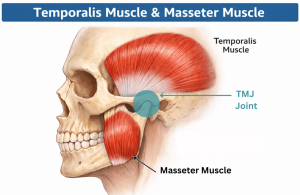
The Anatomy: Why Your Masseter Muscle Matters
Before we dive into the technique, let’s quickly understand what we’re working with.
The Masseter Muscle
Location: Your masseter is a thick, powerful muscle that runs from your cheekbone down to your lower jaw. It sits on the angle of your jaw—roughly halfway between your ear and the corner of your mouth.
Function: This is your primary chewing muscle. It closes your jaw with incredible force—up to 200+ pounds of pressure per square inch.
Why it gets tight:
The masseter is overworked in TMJ dysfunction because of:
- Chronic clenching (conscious or unconscious)
- Nighttime grinding (bruxism)
- Stress (jaw tension as a stress response)
- Poor jaw mechanics (one-sided chewing, clicking/deviation)
- Compensation (trying to stabilize a dysfunctional jaw joint)
- Forward head posture (changes jaw muscle activation patterns)
When your masseter is chronically tight, it:
- Creates localized jaw pain
- Refers pain to your temples, behind your eyes, and upper teeth
- Limits how wide you can open your mouth
- Causes headaches
- Makes chewing painful
- Contributes to clicking and joint dysfunction
The good news? The masseter responds incredibly well to direct pressure and release techniques. You can feel relief almost immediately when done correctly.
The 60-Second Jaw Release Technique: Step-by-Step
Here’s exactly how to do it:
Step 1: Find Your Masseter Muscle (5 seconds)
How to locate it:
- Place your fingertips on the angle of your jaw (about halfway between your ear and chin)
- Clench your teeth gently
- Feel the muscle bulge under your fingers—that’s your masseter
- Release the clench and keep your fingers on that spot
Pro tip: Use 2-3 fingers (index, middle, and ring) for broader pressure distribution. You can use one hand or both hands simultaneously (one on each side).
Step 2: Apply Sustained Pressure (20-30 seconds)
How to do it:
- Press firmly but gently into the masseter muscle
- Start with moderate pressure and gradually increase as tolerated
- Find the most tender spot (this is likely a trigger point)
- Hold steady pressure on that spot
- Breathe slowly and deeply through your nose
What it should feel like:
- A dull, deep ache (not sharp pain)
- “Hurts so good” sensation
- You might feel the pain radiating or referring elsewhere
- The muscle may feel like it’s “melting” or softening under your fingers
What it should NOT feel like:
- Sharp, stabbing pain
- Unbearable discomfort that makes you tense up
- Numbness or tingling
- Pain that shoots into your teeth (ease up if this happens)
Pressure guidelines:
- On a pain scale of 0-10, you should be at a 5-7
- Uncomfortable but tolerable
- You should be able to continue breathing normally
Why this works:
Sustained pressure on a trigger point:
- Increases blood flow to the area
- Encourages the muscle to release chronic tension
- Signals your nervous system to “let go”
- Reduces the sensitivity of the trigger point over time
Research shows that 20-30 seconds is the minimum time needed for trigger point pressure to be effective. Less than that, and you’re just touching the muscle. More than 60 seconds can sometimes cause irritation.
Step 3: Add Movement (20-30 seconds)
This is the secret sauce that makes this technique so effective.
How to do it:
- While maintaining firm pressure on your masseter, slowly open and close your mouth 5-10 times
- Open as wide as comfortable (don’t force it)
- Move slowly and smoothly—no jerking or quick movements
- Keep the pressure consistent throughout the movement
- Continue breathing steadily
What this does:
This is called pressure with movement or active release technique. When you move a muscle while applying pressure to it:
- You’re actively lengthening the muscle fibers under load
- This helps break up adhesions and scar tissue
- It retrains the muscle to relax during normal movement
- It’s significantly more effective than static pressure alone
You should feel:
- The muscle working under your fingers as you open and close
- Gradual softening of the tight tissue
- Increased range of motion with each repetition
- Pain decreasing or changing quality
Variation: Instead of opening and closing, you can:
- Move your jaw side to side (lateral movement)
- Make small circles with your jaw
- Combine opening with side-to-side movement
Choose whichever movement recreates or addresses your specific dysfunction.
Step 4: Release and Repeat on the Other Side (10 seconds)
How to finish:
- Slowly release the pressure
- Take a deep breath
- Notice how your jaw feels—any change in tension, pain, or mobility?
- Repeat the entire sequence on the opposite side
Important: Always do both sides, even if only one side hurts. Your jaw works as a unit, and imbalance between sides can perpetuate dysfunction.
Total Time: 60 Seconds Per Side (2 Minutes Total)
If you’re short on time and can only do one side, choose the side that’s tighter or more painful. But ideally, do both sides for balanced relief.
When to Use the 60-Second Jaw Release
This technique is versatile and can be used in many situations:
1. During an Acute Pain Flare-Up
When jaw pain suddenly intensifies—maybe after eating something tough, a stressful meeting, or waking up with morning tension—use this technique immediately for relief.
Why it helps: Breaks the acute muscle spasm and reduces inflammation before it escalates.
2. After Meals (Especially Tough Foods)
If you’ve just eaten something that required a lot of chewing (steak, bagels, salads), your masseter is fatigued and tight. Give it a quick release.
Why it helps: Prevents post-meal soreness from turning into a full flare-up.
3. When You Catch Yourself Clenching
Set hourly reminders to check in with your jaw. If you notice you’re clenching, release the tension immediately with this technique.
Why it helps: Interrupts the clenching habit before chronic tension builds.
4. Before Bed
Doing this technique as part of your nighttime routine can reduce nighttime grinding and clenching.
Why it helps: Relaxes your jaw muscles before sleep, signaling your nervous system to stay relaxed overnight.
5. First Thing in the Morning
Many TMJ sufferers wake up with jaw soreness from nighttime grinding. This technique can quickly reduce morning stiffness and pain.
Why it helps: Releases the accumulated tension from overnight muscle activity.
6. Before or After Exercise/Workouts
Some people clench their jaw during workouts (especially heavy lifting, running, or high-intensity exercise). Use this before and after to prevent exercise-related jaw pain.
Why it helps: Prevents workout-related jaw flare-ups.
7. During Long Periods of Talking
Teachers, presenters, therapists, salespeople—anyone who talks for extended periods can develop jaw fatigue. Take a quick break and release.
Why it helps: Gives your jaw muscles a mid-activity rest.
How to Get Even Better Results
The 60-second release is powerful on its own, but you can amplify the effects by combining it with these strategies:
1. Apply Heat Before the Technique
How: Place a warm (not hot) compress on your jaw for 10-15 minutes before doing the release
Why it works: Heat increases blood flow, makes muscles more pliable, and enhances the effectiveness of manual pressure
Best for: Chronic tightness, morning stiffness, or before-bed routines
2. Use Ice After the Technique (If Inflamed)
How: Apply an ice pack wrapped in a towel to your jaw for 10-15 minutes after the release
Why it works: Reduces any inflammation triggered by the pressure, numbs residual pain
Best for: Acute flare-ups, post-injury, or when your jaw feels hot/swollen
3. Combine with Diaphragmatic Breathing
How: While applying pressure, focus on slow, deep belly breaths (inhale for 4 counts, exhale for 6 counts)
Why it works: Activates your parasympathetic nervous system (rest-and-digest), which tells your muscles to relax. Breathing also prevents you from tensing up during the pressure.
Best for: Stress-related jaw tension, anxiety-driven clenching
4. Follow with Gentle Jaw Stretches
How: After releasing both sides, do 5-10 gentle jaw stretches:
- Open your mouth slowly and hold at comfortable maximum for 5 seconds
- Move your jaw side to side (5 times each direction)
- Make small circles with your jaw (5 clockwise, 5 counterclockwise)
Why it works: Reinforces the new range of motion you’ve created with the release
Best for: Limited jaw opening, stiffness, clicking
5. Hydrate Immediately After
How: Drink 8-16 ounces of water right after doing the technique
Why it works: Manual therapy releases metabolic waste products from muscle tissue. Hydration helps flush these out and prevents post-release soreness.
Best for: Everyone—hydration supports all muscle recovery
6. Release Related Muscles Too
How: Also apply pressure to:
- Temporalis (temples) – Same technique, but on your temple area
- SCM (side of neck) – Gently pinch and hold the muscle running from behind your ear to your collarbone
- Suboccipitals (base of skull) – Apply pressure where your head meets your neck
Why it works: TMJ is never just about the masseter. Releasing connected muscles creates more comprehensive relief.
Best for: Headaches, neck pain, complex TMJ cases
Common Mistakes to Avoid
Even a simple technique can be done incorrectly. Here’s what NOT to do:
Mistake #1: Using Too Much Pressure Too Fast
The problem: Pressing too hard, too quickly causes your muscle to guard and tense up more
The fix: Start with moderate pressure and gradually increase. Think of it like stretching—ease into it.
Mistake #2: Holding Your Breath
The problem: Holding your breath increases tension throughout your body, including your jaw
The fix: Consciously breathe slowly and deeply throughout the entire technique
Mistake #3: Only Doing One Side
The problem: Your jaw works as a bilateral unit. Imbalance between sides perpetuates dysfunction.
The fix: Always do both sides, even if only one hurts
Mistake #4: Pressing Directly on the TMJ (The Joint Itself)
The problem: The joint is in front of your ear and should not be pressed aggressively. This can cause more irritation.
The fix: Focus on the muscle belly (the thick part of the masseter on your jaw), not the joint
Mistake #5: Doing It Too Often
The problem: Overworking the muscle with constant pressure can cause bruising, soreness, or irritation
The fix: 2-3 times per day maximum for treatment. Once per day for maintenance.
Mistake #6: Expecting It to “Cure” Your TMJ
The problem: This technique provides temporary relief but doesn’t address root causes (posture, clenching habits, joint dysfunction, stress)
The fix: Use this as one tool in your TMJ management toolbox, not as your only strategy
What to Expect: Immediate vs. Long-Term Effects
Immediately After (Within 5 Minutes):
You should notice:
✅ Decreased muscle tension and tightness
✅ Reduced pain intensity (often 30-50% improvement)
✅ Improved jaw range of motion
✅ Softer, less rigid muscle texture
✅ Easier chewing and jaw movement
✅ Reduced headache intensity (if present)
How long it lasts: 1-6 hours, depending on severity and whether you address contributing factors
With Consistent Use (2-3 Times Daily for 1-2 Weeks):
You should notice:
✅ Fewer acute pain flare-ups
✅ Lower baseline tension (jaw feels less tight overall)
✅ Reduced trigger point sensitivity
✅ Better awareness of when you’re clenching
✅ Improved ability to self-manage pain
How long it lasts: Effects become more sustained as muscle tissue remodels and your nervous system learns to stay relaxed
Combined with Comprehensive Treatment (4-8 Weeks):
When used alongside professional TMJ treatment (PT, dentist, habit changes):
✅ Significant reduction or elimination of daily pain
✅ Restored jaw function
✅ Ability to eat normally again
✅ Fewer headaches
✅ Better quality of life overall
Is This Technique Safe? (Precautions and Contraindications)
This technique is very safe for most people, but there are a few situations where you should modify or avoid it:
Proceed with Caution (Lighter Pressure) If:
⚠️ You have active TMJ inflammation (hot, swollen joint)
⚠️ You’ve had recent dental work or oral surgery (wait 1-2 weeks)
⚠️ You have an active jaw infection or abscess
⚠️ You’re pregnant (avoid aggressive pressure)
⚠️ You have a bleeding disorder or take blood thinners
⚠️ You have severe osteoporosis
Stop Immediately If:
🛑 Pain intensifies sharply during the technique
🛑 You feel numbness, tingling, or shooting pain
🛑 Your jaw locks in an open or closed position
🛑 You develop swelling, redness, or warmth after doing it
🛑 Symptoms worsen consistently over 24-48 hours after use
When to See a Professional:
If you’re experiencing:
- Severe, unrelenting jaw pain
- Jaw that locks frequently
- Significant clicking or grinding sounds
- Limited mouth opening (less than 3 fingers wide)
- Pain that doesn’t improve with self-care
…you need a comprehensive evaluation from a TMJ specialist. Self-massage is helpful but not sufficient for moderate to severe TMJ dysfunction.
Beyond the 60-Second Release: Building a Complete TMJ Self-Care Routine
This technique is powerful, but it’s most effective when part of a broader self-care strategy.
Your Daily TMJ Routine Should Include:
Morning (5-10 minutes):
- Gentle jaw stretches
- Suboccipital release
- Heat application (if stiff)
- 60-second masseter release
Throughout the Day:
- Hourly jaw checks (“Am I clenching?”)
- Posture resets every 60 minutes
- Soft diet during flare-ups
- Stress management (breathing, breaks)
Evening/Before Bed (10-15 minutes):
- Warm compress on jaw
- 60-second masseter release
- Gentle stretches
- Breathing exercises
- Relaxation routine (signals jaw to stay relaxed overnight)
Weekly:
- Professional manual therapy/chiro/PT session (during active treatment phase)
- Full-body stress management (exercise, therapy, hobbies)
- Review and adjust habits based on what’s working
Frequently Asked Questions
Q: Can I do this technique more than 3 times per day?
A: You can, but I don’t recommend it. Overworking the muscle tissue can lead to bruising, soreness, or irritation. If you need relief more frequently, alternate with other techniques (ice, heat, stretches) rather than repeatedly pressing the same spot.
Q: Why does it hurt more after I do this technique?
A: Mild soreness for 24-48 hours is normal (like post-workout muscle soreness). This is called “therapeutic soreness” and indicates tissue change. However, if pain intensifies significantly or lasts more than 48 hours, you may have used too much pressure or have underlying inflammation that needs professional attention.
Q: Should I press on both sides at the same time or one at a time?
A: Either works. Pressing both sides simultaneously saves time and creates balanced pressure. Pressing one side at a time allows you to focus more intently on each side and may be easier for beginners.
Q: Can I use a tool instead of my fingers?
A: Yes! Tools like a Theracane, massage ball, or even the eraser end of a pencil can provide more sustained pressure without tiring your hands. Just be careful not to use excessive pressure with harder tools.
Q: My jaw clicks when I open during this technique. Is that bad?
A: Clicking during the technique is common and not necessarily harmful. However, if the clicking is painful or your jaw catches/locks, ease up on the pressure and reduce your range of motion during the movement phase. If clicking persists or worsens, see a TMJ specialist.
Q: How long will it take before I don’t need to do this anymore?
A: That depends on the severity of your TMJ dysfunction and whether you’re addressing root causes. Some people use this technique intermittently during stressful periods. Others need it daily as part of ongoing management. The goal is to reduce frequency over time as your jaw becomes healthier.
Q: Can kids or teenagers do this technique?
A: Yes, absolutely. TMJ dysfunction affects children and teens too (often related to orthodontics, sports injuries, or stress). Teach them to use lighter pressure and supervise initially to ensure they’re doing it correctly.
The Science Behind Manual Trigger Point Therapy
If you’re wondering why pressing on a muscle provides relief, here’s the research:
What Studies Show:
Trigger Point Research:
- Sustained pressure (20-90 seconds) on trigger points significantly reduces pain and muscle tension (Hou et al., 2002)
- Ischemic compression (pressure) increases local blood flow and oxygenation after release (Hanten et al., 2000)
- Manual therapy combined with active movement is more effective than passive techniques alone (Fernández-de-las-Peñas et al., 2006)
TMJ-Specific Research:
- Massage and manual therapy reduce pain and improve function in TMJ patients (Martins et al., 2016)
- Self-administered massage provides comparable benefits to professional therapy when done correctly (Türp et al., 2007)
- Myofascial release techniques significantly improve jaw range of motion and reduce pain (Kalamir et al., 2012)
Bottom line: This isn’t just anecdotal—it’s backed by solid research showing that manual pressure works.
Real Patient Experiences
David, 39 – Software Engineer:
“I learned this technique in my first treatment session and it’s been a game-changer. I keep my jaw pretty tense during the day from stress, and now when I feel it building, I just step away from my desk for 60 seconds and reset. It’s wild how much relief I get from something so simple. I still go to Dr. Baird twice a month for deeper work, but this gets me through the day-to-day stuff.”
Amanda, 27 – Teacher:
“Talking all day wrecks my jaw. By 3pm I used to be in so much pain I could barely eat dinner. Now I do this technique during my lunch break and after school, and it makes such a difference. I also do it before bed because I grind my teeth at night. My morning jaw pain is way better now.”
Carlos, 52 – Restaurant Manager:
“I was skeptical that something so simple would work, but when my chiropractor showed me this in the office and I felt instant relief, I was sold. I do it every morning in the shower (the heat + the massage is perfect) and whenever I feel my jaw getting tight. It’s not a cure, but it definitely helps me manage my symptoms.”
Conclusion: A Simple Tool, Profound Impact
The 60-second jaw release technique isn’t magic. It’s not going to cure chronic TMJ dysfunction on its own. And it’s not a substitute for professional treatment if you have moderate to severe jaw problems.
But here’s what it IS:
✅ A fast, effective way to manage acute jaw pain and tension
✅ A tool that empowers you to take control of your symptoms
✅ A technique backed by research and clinical experience
✅ Something you can do anywhere, anytime, for free
✅ A valuable addition to your TMJ self-care toolkit
The beauty of this technique is its simplicity. You don’t need equipment, appointments, or medications. You just need 60 seconds and the knowledge of what to do.
And now you have that knowledge.
Take Action Today
Step 1: Try the technique right now. Put this article down, place your fingers on your masseter, and work through the steps. Notice how your jaw feels before and after.
Step 2: Set 2-3 reminders in your phone to do this technique today. Build the habit.
Step 3: If you’re dealing with chronic jaw pain, limited opening, clicking, or headaches, this technique will help—but it’s not enough on its own.
Book an initial consultation with our TMJ specialist doctor in Oakland. We’ll assess your jaw comprehensively, teach you personalized techniques, and create a treatment plan for lasting relief.
Located in Oakland, CA and serving the greater Bay Area. We combine evidence-based manual therapy, exercises, and patient education to help you achieve pain-free jaw function.
BOOK YOUR INITIAL CONSULTATION →
Related Resources:
📖 The One Stretch Every TMJ Patient Needs to Know 📖 Massage These 3 Spots to Relieve Jaw Tension 📖 Ice vs. Heat for TMJ Pain: When to Use Each 📖 Why Your Headaches Might Be Coming From Your Jaw
About the Author:
Dr. Sandy Baird, DC is a Doctor of Chiropractic specializing in TMJ dysfunction and neck pain. With 15+ years of experience treating jaw pain in Oakland, CA, Dr. Baird has taught thousands of patients this exact technique during first-time evaluations. Dr. Baird combines hands-on manual therapy with patient education to provide lasting relief without surgery or invasive procedures.